Context Profiles Quantitative Qualitative Personas Findings Reflections
UX Research Mixed Methods Qualitative Quantitative

401 voices.
What does it take to build a UX career abroad?

Many Brazilian UX designers dream of an international career — but the path is full of assumptions, fears, and unanswered questions. I set out to find real answers. Not myths. Not LinkedIn success stories. The truth.

401
Survey responses
25
In-depth interviews
3
Personas developed
95%
Confidence level
Timeline
Aug 2023 – Dec 2024
My Role
Researcher · Interviewer · Analyst
Tools
Miro · Notion · SurveyMonkey · Figma
Published
UX Career cover
🔍

The dream is real.
So are the doubts.

Many Brazilian UX designers consider an international career at some point. Some think it's impossible. Others idealise it completely. Very few have access to honest, grounded information about what the journey actually looks like.

This project started from a personal question — and became a rigorous research study. Together with a small team, I designed and conducted a mixed-methods investigation to understand the real barriers, enablers, and turning points in the journey to an international UX career.

The research was published and made freely available to the Brazilian UX community.
The core question
"How do you really get an international career in UX design — and what does nobody tell you about it?"

Three profiles. One shared dream.

Before recruiting participants, I conducted desk research to map who the Brazilian professionals seeking international UX careers actually were. This gave us three distinct profiles to guide the research design.

01
The Dreamer
Wants to start a UX career abroad but doesn't know how yet. Has enthusiasm and motivation, but lacks a concrete plan or enough information to take the first step.
02
The Prepared
Already participating in selection processes outside Brazil. Has advanced English and some experience, but still has doubts about visa, relocation, and standing out in a foreign market.
03
The One Who Made It
Already living and working abroad as a UX Designer. Has the perspective of someone who went through the full journey — and can reveal the real experience behind the LinkedIn posts.

401 responses.
At 95% confidence.

A questionnaire was distributed across LinkedIn, WhatsApp, and Telegram groups focused on UX professionals. Using the SurveyMonkey sample calculator, we determined we needed 370 responses for 95% confidence.

We collected 401 responses, of which 376 fit the profile criteria. The results were segmented across the three profiles identified in the desk research phase.

The quantitative findings gave us patterns and proportions — a foundation for the deeper qualitative work that followed.

401
Total responses collected
376
Valid responses used
95%
Statistical confidence level
3
Platforms for distribution

25 conversations.
25 honest stories.

Qualitative interviews were conducted remotely via Google Meet with 25 participants, plus 3 mentor sessions with experienced UX professionals. Each interview had tailored objectives per profile — different questions for those still in Brazil versus those already working abroad.

🌍
Travel experience matters more than expected
Most who successfully moved abroad had previously visited or lived in that country. Familiarity with the culture and knowing people there significantly reduced the difficulty of transition.
🗣️
Language is the #1 enabler
Advanced English — or the local language — was consistently cited as the most critical factor by those who had already made the transition successfully.
📉
Difficulties were less than feared
Those who had moved reported that the actual difficulties — housing, financial stability, logistics — were significantly less than they had anticipated before moving.
Unexpected finding
"Most people overestimate how hard it will be to move — and underestimate how important it is to have visited the country first."
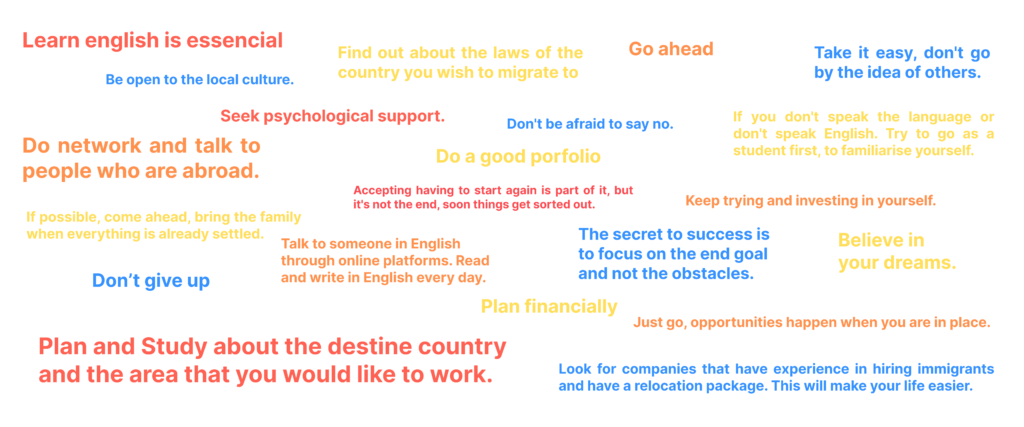
Motivation word cloud
☁️

Three real people.
Three real journeys.

The research data was synthesised into three detailed personas, one for each profile. These weren't generic archetypes — they were built directly from the language, fears, and goals of the real people interviewed.

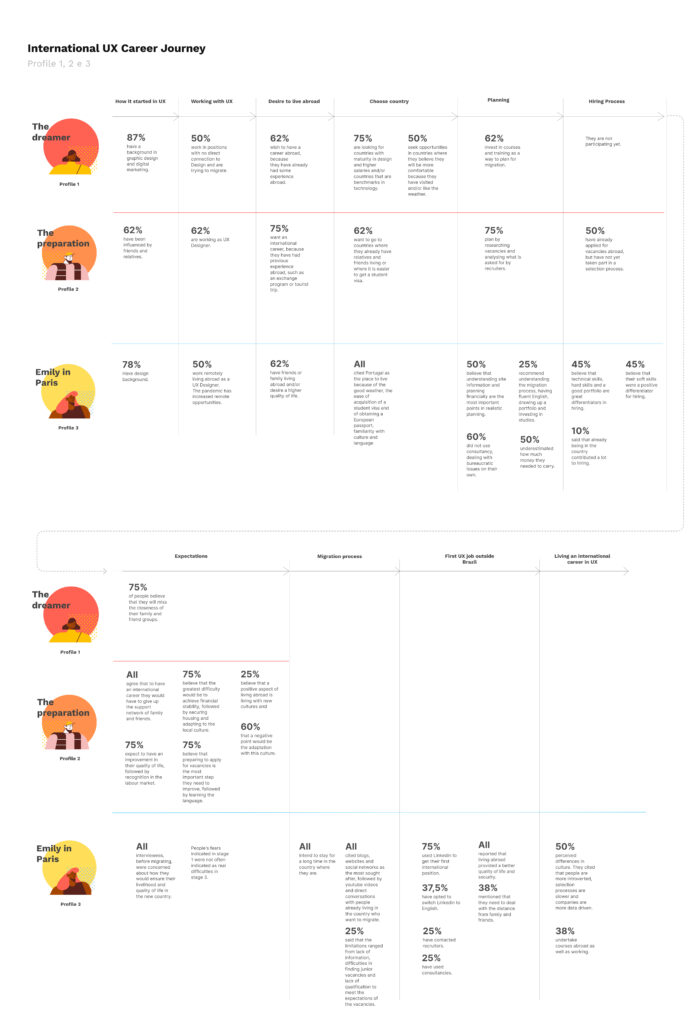
Jaqueline (25, junior, intermediate English) — has the dream but doesn't know where to start. Her biggest pain: imposter syndrome and not knowing what qualifications are really required.

Rafael (29, mid-level, advanced English) — one foot in Brazil, the other outside. Already applying abroad, but worried about interviews in a second language and being overlooked as an immigrant.

Gabriela (32, senior, fluent) — already living in Portugal with a work visa. She considers planning and language fluency the two most critical factors. Her challenge now: tax bureaucracy and cultural adaptation.

User journey map
🗺️

What the data actually revealed.

✈️
Tourism as a gateway
Most successful migrants had a prior connection to the destination country — through tourism, exchange, or existing social networks. Cold moves were far more difficult.
🏢
Company matters more than country
Many people migrate for a specific company rather than a country. The employer relationship matters more than geography — especially for remote-first roles.
💔
The biggest loss: support network
The most frequently cited sacrifice was leaving behind the family and friends support network in Brazil. This emotional cost was consistently underestimated before moving.
🎓
European citizenship changes everything
Having (or obtaining) European citizenship significantly reduced the bureaucratic and psychological barrier to moving to EU countries.
💰
6 months of savings: minimum viable
Research consistently pointed to having at least 6 months of financial reserve in the new country as a critical safety net for a successful transition.
🔗
LinkedIn is the primary channel
Networking via LinkedIn and having a strong, international-facing profile was the most cited enabler for landing the first international role.

What this research taught me.

01
Recruiting users takes skill. Managing interview schedules, handling no-shows, and adapting questions on the fly were skills I developed through practice across 25 sessions.
02
Analysing large datasets requires structure. Going from 401 survey responses to actionable insights required rigorous organisation. I developed processes I now use in every research project.
03
Every story is unique — and that's the point. There's no magic formula for an international career. The richness of this research came from respecting individual stories while finding patterns within them.
04
Pace matters in long projects. We chose to run this project at our own pace over 6 months. That decision let us learn deeply at each stage — and produced better research than rushing would have.
Next project

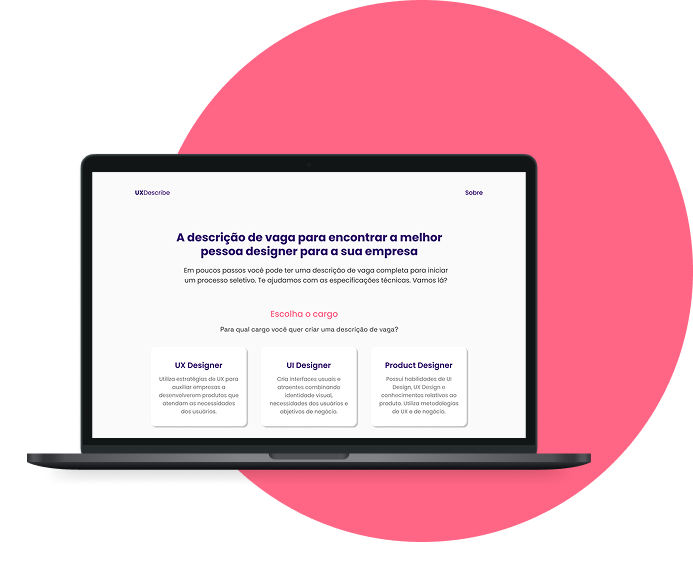
UX Describe — Job Description Tool

Both sides of the hiring table were frustrated. I designed a B2B platform to fix the gap between tech recruiters and UX professionals.

See case study →
UX Describe